
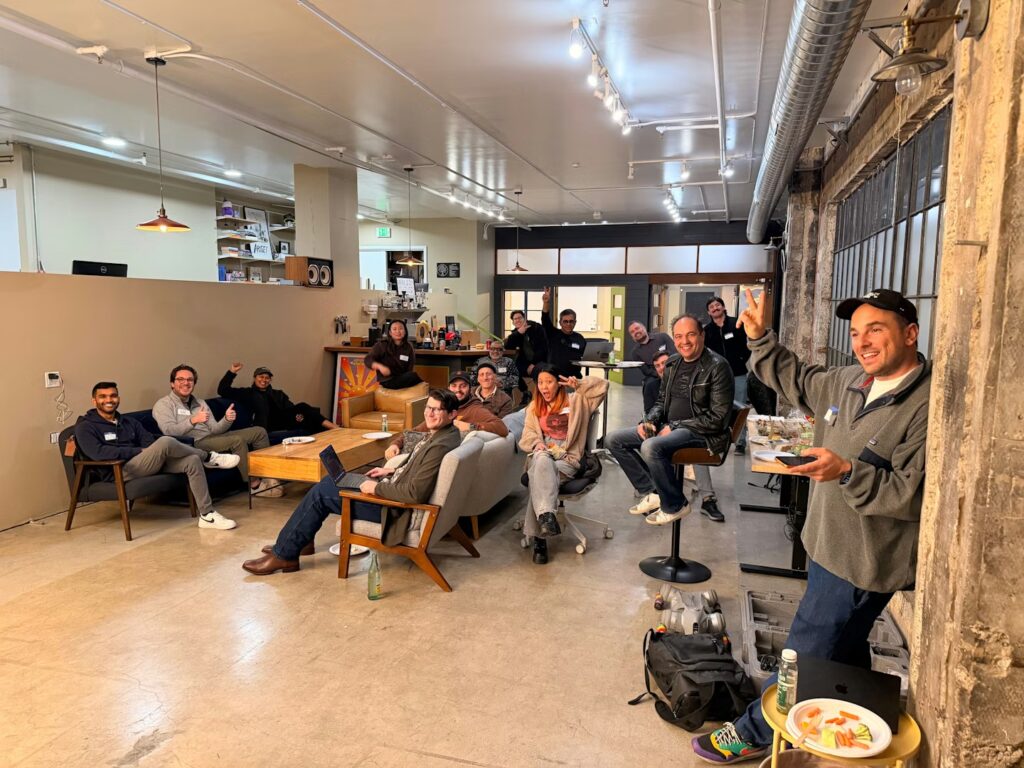
Last Wednesday, I hosted the first Claude Code Show & Tell in San Francisco. Twenty people showed up to Root Ventures‘s office (thanks guys for hosting!), I brought some fruits, veggies, chips & hummus (I got roasted for not ordering pizza), stuck on name tags, and watched six people demo how they’re actually using Claude Code in their work.
The presenters ranged from a designer to a non-technical founder to a veteran engineer who’s been coding since the early days of computers. Here’s what they shared.
The Format
We started with an icebreaker: “What questions do you have about Claude Code?” This served two purposes – it surfaced what people wanted to learn, and it connected people who had answers to people who had questions. Some folks wanted to know about remote Claude Code setups. Others were brand new and didn’t know where to start.
Six demos. Two hours. Twenty people. Name tags. Snacks that weren’t pizza.
The Demos
MSG (me) kicked things off with a demo of Contains.email, a Claude Code newsletter I started last week. It analyzes all mentions of Claude Code on X daily and sends an email digest covering best practices and tips, new features, workflows and strategies, and cool demos and comments from the community.
Jie Gao (@thejieg) – a designer – showed off a Chrome extension that saves contextual explanations tied to source material. The vision: collaborative, multimodal learning from curated snippets. She’s got a waitlist up at site-pi-sable.vercel.app while she buttons things up.
Cam Glynn (@financialvice) demoed a generative IDE controlled by Claude Agent – canvas spawning sub-agents to build multiple apps simultaneously, animating and navigating the canvas. He walked through the limits of multi-agent orchestration UX and where things break down.
Ajay Kulkarni (@acoustik) demoed 0perator, an AI tool that works with Claude Code that makes architectural decisions to build full-stack apps. His motivation? Claude Code asks too many stack questions and defaults to generic design aesthetics. 0perator makes those decisions for you.
Rob Haisfield (@RobertHaisfield), a non-technical cofounder of WebSim, walked through his workflow using Claude Code/Conductor and the browser extension to ship features, analyze data, and automate UI tasks. Key insight: environment variable management matters more than you’d think.
Nitin (@nitin), an experienced engineer, showcased Claude-assisted workflows spanning embeddings research, project memory files, GPT-2 experiments, and a code/JIRA browsing tool he built quickly.
Joshua Levy (@ojoshe) made the case for spec-driven development to reduce “slop code.” He demoed a Claude-built TypeScript CLI testing framework and shared his docs/rules for context engineering. His projects are open source:
What People Said
Ben summed it up nicely lol: “this was awesome, thanks for hosting @msg”
Next Event: January 21st
I’m hosting these twice a month now. The next one is Wednesday, January 21, 2026.
RSVP here: partiful.com/e/8df3XMoDe35jCRSACcZK
If you want to demo something, reach out. Designers, PMs, founders, engineers – all welcome. The best part of the first event was seeing how differently people use the same tool depending on their background and what they’re trying to build.
Hope to see you there.